We provide an array of tailored wellbeing solutions to address human capital losses and unlock higher performance.
Gain a competitive performance edge through investing in organizational flourishing
Achieve “more” with “less”. Build technical and managerial skills to execute business strategies
We provide an array of tailored wellbeing solutions to address human capital losses and unlock higher performance.
Gain a competitive performance edge through investing in organizational flourishing
Achieve “more” with “less”. Build technical and managerial skills to execute business strategies
Home › Insights › Corporate Wellbeing Programs
Founder & CEO, Happiness Squad · Former McKinsey Partner · Author of Hardwired for Happiness
Reviewed
· 16 min read
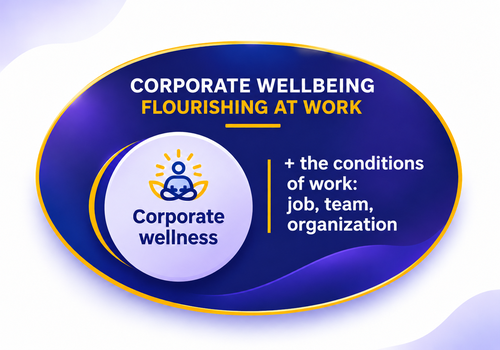
A corporate wellbeing program, also called a flourishing-at-work program, supports the whole person and changes the work conditions around them so people and teams can thrive and perform. Corporate wellness (apps, EAPs, gym passes, workshops) is one part of it.
The strongest programs act on four levers at once: the individual, the team, the job and its manager, and the organization.
Global value of investing in employee health
of burnout drivers sit in the job itself
of US workers say they are thriving at work
of companies focus staff surveys on wellbeing
Sources: WEF with McKinsey Health Institute, 2025 · McKinsey Health Institute, 2023 · Indeed, 2025 · S&P Global, 2024
McKinsey Health Institute, 2023 (30,392 employees, 30 countries)
Indeed Work Wellbeing Report 2025 (4,038 US adults, with Forrester); Indeed Global Report 2024 (25M+ respondents, with Oxford)
Happiness Squad survey of nearly 1,000 full-time workers, Nov 2024 (The Flourishing Imperative)
Fleming, Industrial Relations Journal, Oxford Wellbeing Research Centre, 2024
Deloitte Well-being at Work Survey, 2024 (3,150 respondents)
McKinsey percentages are each level’s share of the differences the model explains between employees.
A corporate wellbeing program is an organization-wide effort that supports the whole person and changes the conditions of work, so people and teams can thrive and perform. Some buyers call these corporate health and wellbeing programs. At Happiness Squad, corporate wellbeing and flourishing at work mean the same thing.
The difference that matters is between wellness and wellbeing. Corporate wellness is a part of corporate wellbeing.
At Happiness Squad, we treat wellbeing at work as a performance unlock, not just as a benefit. Our Flourishing Edge program is a corporate wellbeing and leadership program, owned by line leaders and measured like any other business result.
Gym passes, screenings, step challenges, EAPs, apps, workshops, flexible work
Most corporate wellbeing programs fail because they are really wellness programs. They work on the individual and leave the job, the team and the organization unchanged.
About 9 in 10 organizations offer some form of wellness benefit. In a 2023 survey of 87 leaders by Hintsa Performance, 69% called wellbeing a priority, but only 28% had a multi-year strategy and 58% had no dedicated budget. Across 4,413 companies, S&P Global found only 2.2% make wellbeing the focus of their employee survey, and just 10% ask about stress.
About 90% of executives believe their company has a positive effect on worker wellbeing, but 60% or fewer workers agree. Only 32% of workers said their mental wellbeing improved last year, while at least 7 in 10 executives believed it had.
McKinsey Health Institute (MHI) found many companies over-index on individual interventions. A meditation app is valid support, but it does not fix the structural issues that cause strain.
In MHI’s model, workplace demands such as toxic behavior, role ambiguity and workload were seven times more predictive of burnout than enablers. Individual factors explained just 3% of burnout.
Dr William Fleming at Oxford compared 46,336 workers in 233 UK organizations. Those who used resilience training, mindfulness, stress management, coaching or wellbeing apps reported no better wellbeing than colleagues who did not. People in resilience and stress training were more likely to report unrealistic time pressure. Fleming’s reading: the programs did not match the demands of the job. Volunteering was the only exception, linked to a stronger sense of belonging.
Across 160 BJ’s Wholesale Club sites and about 33,000 workers, a broad wellness program showed no significant change in clinical health, healthcare spending or tenure after 18 months.
The US Surgeon General’s framework cites Mental Health America data: only 38% of workers who knew about their organization’s mental health services would feel comfortable using them.
When McKinsey asked employers why people quit, they named pay, work-life balance and health. Employees named relationships: not feeling valued by the organization (54%) or their manager (52%), and lacking belonging (51%). Indeed’s 2025 driver analysis tells the same story: energy (16%) and belonging (16%) drive work wellbeing far more than fair pay (8%) or flexibility (5%).
Think of a wilting plant. Spraying the leaves helps for an hour. Fixing the soil, the water and the light helps for a season.
Wellness sprays the leaves. Wellbeing fixes the soil.
Effective corporate wellbeing programs act on four levers at once: the individual, the team, the job and its manager, and the organization. MHI’s research shows how much each lever matters.
Source: McKinsey Health Institute, 2023 (30,392 employees, 30 countries). The organization’s share looks small because its effect flows through jobs and teams. Leaders set the workloads and norms managers live with.
What to change: self-efficacy, adaptability, energy management, making stress an ally.
Why: self-efficacy and adaptability are the top two drivers of holistic health in MHI’s data, and both are trainable. Individual skills help most when the other three levers are working.
In practice: Monzo trains staff to use short “energy breaks” through the day.
What to change: psychological safety, appreciation, constructive conflict, how the manager leads.
Why: WHO guidelines recommend, for the first time, training managers to prevent stressful environments and respond to people in distress. Workers expect their direct manager to influence their wellbeing more than executives, HR or the CEO (Indeed, 2025). Gallup found manager engagement fell from 27% to 22% in 2025 alone.
In practice: Sempra runs psychological safety training for senior managers and team leaders; Capgemini trains managers in conflict resolution.
What to change: workload, role clarity, conflicting demands, autonomy, time for focused work.
Why: WHO recommends organizational interventions that reduce heavy workloads and low job control, linked to lower distress and better absenteeism, satisfaction and performance. In our own survey, 46% of workers could not say they rarely face conflicting demands.
In practice: McKinsey uses pulse checks and team retros to catch mismatches between workload and staffing; Lightspeed caps working hours per day.
What to change: working norms, leadership commitment, incentives that count team health.
Why: leaders set the norms every team works within. Put team health on leaders’ dashboards next to team performance.
In practice: Snaptrip sets breaks between meetings and no email after 9pm or at weekends; McKinsey feeds confidential upward feedback on leadership behavior and team wellbeing into performance reviews.
Company examples come from the McKinsey Health Institute Employee Health Platform action compendium.
Where to start: MHI’s advice is to start with the job and team levers to reduce burnout, and to act on all four to improve holistic health.
The US Surgeon General’s framework for workplace wellbeing reaches the same place from a public health angle. Its five essentials are protection from harm, connection and community, work-life harmony, mattering at work and opportunity for growth, all built on worker voice and equity. Every one of them is about the conditions of work, not individual perks.
AI is raising the bar on the human skills that wellbeing protects. A January 2026 report from the McKinsey Health Institute and the World Economic Forum calls these skills, together with brain health, brain capital.
Across 30 countries, adaptability and self-efficacy were the leading drivers of whether employees felt they were thriving, not just performing.
More than one in five employees globally report burnout symptoms, and the ability to use AI tools well has grown sevenfold in two years, adding new cognitive demands.
Workers at companies that prioritize wellbeing are more likely to adapt to AI. People with high work wellbeing achieve most of their goals far more often (93% vs. 62%).
Sources: WEF with MHI, The Human Advantage, 2026; Indeed, 2025. This is why Adaptability sits in the PEARL Model™, below.
The first three types below are corporate wellness. The rest are what turn wellness into wellbeing.
Wellness rows are useful. They are one layer of a wellbeing program, not the program.
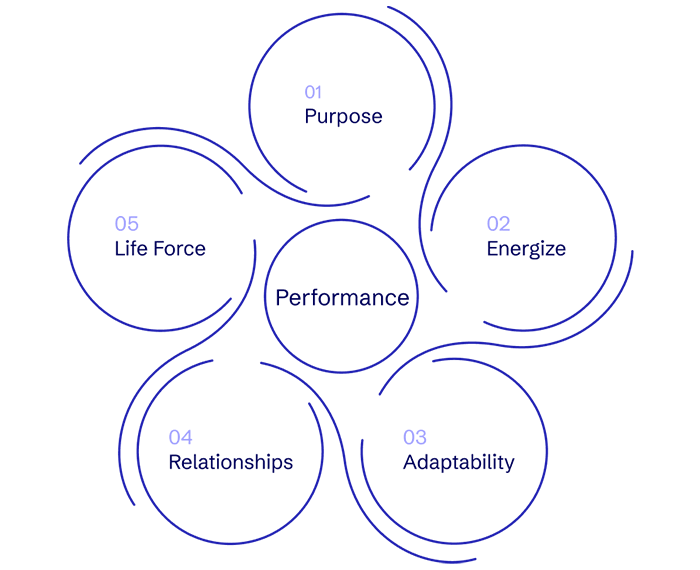
Happiness Squad organizes corporate wellbeing around five drivers that leaders and managers can influence every day. Our survey of nearly 1,000 full-time workers in November 2024 shows where each one stands (The Flourishing Imperative).
People see meaning in their work and how it connects to something larger. 31% of workers did not feel their work has meaning beyond a paycheck.
Daily interactions leave people energized, not drained. 38% did not feel highly energized by their interactions at work. Energy was the strongest predictor of both happiness at work and job satisfaction. Indeed’s 2025 US data agrees: energy is the top driver of work wellbeing, yet 42% of workers do not feel energized.
People and teams can move forward when the path is unclear, and grow through change. 29% did not feel confident moving forward when the path was unclear. Adaptability had the strongest link to productivity, and WEF and MHI name it a core brain skill for the age of AI. Our white paper Cultivating Adaptability goes deeper.
People trust their team and feel safe to speak up. 90% said their team trusts them to do their job, yet 24% could not ask questions or admit mistakes without fear of judgment. In Indeed’s 2025 data, 37% of US workers do not feel they belong and 40% do not trust people in their company.
Work is designed around how the brain works, with sustainable workloads and time to focus. 31% did not feel their stress at work is manageable. Life-Force was the strongest predictor of lower burnout.
Each driver maps to something a manager can change on Monday. That is the point. A framework only HR can act on will stay in a slide deck.
Attrition in one function, burnout in client-facing teams, or slow delivery. Wellbeing is the means, not the goal.
Programs owned by the business get acted on. Programs owned only by HR often stay optional.
Cut results by team, location and function, across all four levers. See how to measure, below.
Start where the data shows the most strain. Typical first moves: fewer conflicting demands, meeting-free blocks, clearer priorities, realistic workloads.
Most managers are promoted for technical skill and never taught to coach, run good meetings or spot distress.
Coaching, EAP and skills programs help most when the system around them is healthy.
Re-test the pilot group a few months after launch, as MHI recommends, then every quarter. Annual surveys arrive too late: by the time results come back, many respondents have left.
Measure wellbeing at team level, across the four levers, and repeat it every quarter. Company-wide averages hide the teams that are struggling.
The OHPI (Organizational Human Potential Index). Happiness Squad’s OHPI diagnostic measures the five PEARL drivers and estimates the human capital potential an organization is leaving unused. Results are cut by team, location and function, and measured continuously rather than once a year. Most employee surveys stop at engagement or satisfaction: across 4,413 companies, S&P Global found only 2.2% focus their survey on wellbeing, and just 10% ask about stress. The OHPI shows which teams are losing capacity, and why. Leaders can start with our free Flourishing Assessment, a short version drawn from the OHPI that estimates their organization’s opportunity in a few minutes.
Where human capital potential is lost, % of full potential
Source: Happiness Squad, The Flourishing Imperative (May 2026).
WEF and MHI both recommend tracking a short list over time rather than everything at once.
Participation is the most reported metric and the least useful. A program everyone attends can still change nothing.
Investing in employee health could create $3.7 trillion to $11.7 trillion in global economic value, about $1,100 to $3,500 per employee, according to McKinsey Health Institute analysis published with the World Economic Forum. Most of that value comes from productivity, not cost savings.
Better productivity and less presenteeism account for 54% to 77% of the value. Attrition and absenteeism, the easiest costs to count, make up only one-eighth to one-quarter. ROI cases built only on sick days and turnover undercount the return.
McKinsey estimates disengagement and attrition could cost a median-size S&P company $228 million to $355 million a year in lost productivity.
By Happiness Squad’s estimate, most organizations operate at about 53% of their human capital potential, compared with 60% to 85% for physical assets. Across industries, our 2024 survey data ranges from 48% in education to 64% in travel, logistics and infrastructure.
Published studies of wellbeing program ROI range widely, with most positive. Broad, untargeted programs tested in randomized trials, such as the BJ’s study, show weak returns. Programs aimed at a specific, measured problem show the clearest payback. At company level, Oxford research across 1,782 companies found a one-point rise in average employee happiness was linked to 1 to 1.2 points higher return on assets and $1.39 billion to $2.29 billion more in annual profits, as reported by S&P Global.
Say a program costs $60,000 for a cohort of 30 people, each paid $100,000 a year. Gallup estimates replacing a manager costs about 200% of salary, and a technical professional about 80%. Taking one to two times salary as the range, if the program keeps just one of those 30 from leaving, it saves $100,000 to $200,000. That is 1.7 to 3.3 times the program cost, before any gain in productivity.
Program cost
$60,000
Participants
30
Salary per participant
$100,000
Cost to replace one person (1 to 2 times salary)
$100,000 to $200,000
Return if one person stays
1.7x to 3.3x
Yes, when it changes daily work. The top three reasons people give for quitting are relational: not feeling valued by their organization (54%), not feeling valued by their manager (52%) and lacking belonging at work (51%), according to McKinsey’s survey of workers in five countries. After pay, stress is the leading reason US workers start looking for a new role (24%), per Indeed’s 2025 data. People leave managers, workloads and teams more often than they leave a benefits package.
External results show what is possible when a program is targeted and measured:
A program for more than 2,500 employees, delivered with Kyan Health, cut voluntary attrition by 30% and returned $2.9 million a year, an 11.6x ROI. WEF, 2025
Used HR data to target support where people were most at risk of leaving. Attrition fell 4%, saving $14 million over two years. WEF, 2025
Companies whose employee surveys focus on wellbeing averaged 11% voluntary turnover, against 12% for companies focused on engagement or satisfaction, at a time when turnover rose in every sector. S&P Global, 2024
Companies with a strong culture of health see employee turnover 11 percentage points lower than those without one. As cited by WEF
Of workers, managers and the C-suite say they would seriously consider leaving for a company that better supports their wellbeing. Deloitte, 2024
Cost depends on scope. App and platform programs are usually priced per employee per month. Team and manager programs are usually priced per cohort or per engagement. Assessment-led programs add a measurement fee.
At Happiness Squad, cohort-based leadership and team programs typically run $3,000 to $5,000 per participant.
The better question is cost against the problem you are solving. Compare the program price to the cost of replacing the people you are losing, as in the worked example above.
Ask every provider these questions:
A provider that answers mostly with participation numbers is selling reach, not results.
Corporate wellbeing programs, also called flourishing-at-work programs, are organization-wide efforts that support the whole person and improve the conditions of work. Effective programs act on four levers: the individual, the team, the job and its manager, and the organization.
Corporate wellness supports the individual’s physical, mental, social and financial health through tools like apps, EAPs and gym passes. Corporate wellbeing includes wellness and also changes the conditions that let people and teams thrive. Wellness is one part of wellbeing.
The best programs share five traits: a clear business problem, line-leader ownership, team-level measurement, manager development and changes to how work is designed. Individual support sits on top of these, not in place of them.
Programs built only on individual perks show little measurable benefit in large studies. Programs that change workloads, manager behavior and team practices are supported by WHO guidance and McKinsey Health Institute research, which finds 94% of burnout drivers sit at the job and team levels.
McKinsey Health Institute estimates investing in employee health could create $1,100 to $3,500 of value per employee. A targeted program can pay back by keeping even one person from leaving, since replacing someone can cost one to two times their salary.
It depends on scope. Apps are priced per employee per month; team and manager programs per cohort. Happiness Squad’s cohort programs typically run $3,000 to $5,000 per participant.
Build it into the workday through managers and team routines, rather than asking people to opt in after hours. Engagement follows relevance.
MHI recommends re-testing a pilot group a few months after launch before scaling. Shifts in team practices show first. Health and cost outcomes take longer.
Start by finding where wellbeing is strongest and weakest across your teams, or see how our Flourishing Edge program works with leaders and teams.
Founder & CEO, Happiness Squad
Ashish is a former Partner at McKinsey & Company, where he spent over two decades helping leaders and organizations achieve breakthrough performance. He is the author of Hardwired for Happiness and gave the TEDx talk “How to Make Flourishing Your Competitive Edge”.