What an Employee Engagement Program Really Is (and Why the Standard Definition Falls Short)

Ask ten leaders to define an employee engagement program and you tend to get ten versions of the same answer. An annual survey. A recognition platform, organizational health assessment. A few perks, an annual pulse check, maybe a technology solution. The tools vary, but the assumption underneath them almost never does. Engagement is treated as something you install, a program you buy, switch on, and roll out.
That assumption is a big part of why so many programs fall short. Global engagement has slipped to about one in five employees, the lowest Gallup has recorded in years, and the productivity lost to disengagement now runs to roughly $10 trillion a year. None of this is happening because companies stopped spending. Budgets for employee wellness, employee wellbeing programs and engagement initiatives have risen over the last decade. The money is going out. The needle is not moving.
The reason, in most cases, is that the program is aimed at the wrong thing. So before the practical questions (what a program is, how to build one, what a good one looks like), it is worth going back to the definition itself, because the standard one quietly works against you.
A better definition: engagement is an outcome, not an initiative
Here is the definition worth making the norm.
An employee engagement program is not a set of activities you run at people. It is the deliberate design of the conditions in which people can bring their full capability to work, plus the systems that keep those conditions healthy over time.”
The difference sounds academic. It is not. Treat engagement as an initiative and success starts to look like participation: how many people opened the survey, logged into the platform, showed up to the workshop. Treat it as an outcome and the questions change. Are people thinking more clearly? Collaborating more openly? Staying longer? In other words, did the conditions for good work actually improve, or did we just run some activities near people who needed something else entirely.
Most programs measure the first set of questions and quietly hope they add up to the second. They rarely do. Activity is not capability. A meditation app will not touch an impossible workload, and no recognition platform repairs a manager who was never taught to lead. There is no perk that fixes a structural problem, however good the perk.
Why the standard definition falls short: the misdiagnosis problem
The McKinsey Health Institute studied this across 15 countries and found something most engagement and wellbeing programs quietly ignore. The strongest predictors of burnout are not individual traits or a lack of personal resilience. They are workplace factors: toxic behavior, unsustainable workload, weak management, and the daily friction of how teams actually operate. Toxic workplace behavior alone was the single biggest predictor of burnout symptoms, by a wide margin.

That finding should change how the budget gets spent. A wellness stipend handed to an individual does nothing about a toxic manager or an impossible workload, which is where the real damage lives. A team lunch or and employee offsite does little to overcome the daily friction losses from broken ways of working. It is why a company can point to a generous engagement budget and a flat set of scores in the same breath and not see the contradiction. The spending is real. It is simply pointed at the wrong part of the problem.
A real employee engagement program works the other way round. Find the workplace conditions doing the damage first, then design against them.
Engagement, satisfaction, and wellbeing are not the same thing
A quick bit of cleanup, because these three words get used as if they were interchangeable and it muddies everything built on top of them.
- Satisfaction is about the deal. Are people content with the pay, the benefits, the conditions? Someone can be perfectly satisfied and still coast for years.
- Engagement is about effort and involvement. Does someone bring their full attention and judgment, or do they show up and comply? A person can be under real pressure on a hard project and still be deeply engaged, precisely because the work matters to them.
- Wellbeing is about how people are actually doing across their energy, health, and sense of meaning, at work and outside it.
This is where corporate wellbeing programs , wellness investments and engagement programs get tangled together. They are related, but they are not the same. Traditional employee wellness programs lean toward physical-health perks: the gym membership, the step challenge, the stipend. Useful, and narrow. The two only compound each other when wellbeing is treated as one of the conditions for engagement rather than a separate line on the benefits sheet. Engagement without wellbeing burns people out. Wellbeing without engagement gives you people who are comfortable and checked out. A serious program has to hold both at once.
What the conditions actually are: the flourishing view
If engagement comes down to conditions, you need a map of which conditions matter. At Happiness Squad we read this through the lens of flourishing, the idea that people do their best work not when they are merely comfortable but when they are genuinely thriving across a few connected dimensions at the same time.
Our PEARL framework names five of them.
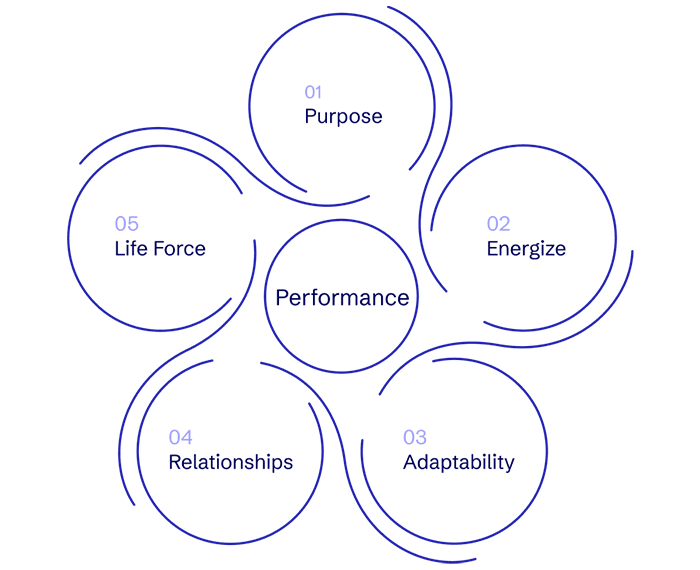
- Purpose. People can see how their particular work connects to something they actually care about, beyond the paycheck.
- Energy. People work in rhythms they can sustain, rather than running on a chronic depletion that gets mistaken for commitment.
- Adaptablity. People, and their managers, can leverage their strengths and build the adaptability muscle to keep learning and growing their capacities to navigate change
- Relationships. There is enough psychological safety and belonging that honest conversation is actually possible.
- Life Force. The underlying vitality that decides whether someone is fully present or just moving through the motions.
These dimensions behave like a system, which is the whole point of the broaderPEARL model of flourishing. Tend to one and neglect the rest and the thing wilts anyway. A wellness perk nudges a corner of Energy and calls the job done. A genuine program works all five together, because they hold each other up. Purpose with no energy behind it just burns people out faster. Relationships with no self-awareness stay stuck on the surface.
How to redesign your employee engagement program
This is the question most people arrive with, so here is a build order that survives past the first quarter. Notice how far down the list buying a tool actually sits.
- Diagnose before you design. Do not pick initiatives until you know what is actually driving the disengagement. Start with data you already hold, like retention, absenteeism, and performance patterns broken out by team, then add a short pulse on purpose, workload, and how people feel about their manager. A yoga class does nothing for a team that mainly feels unheard.
- Segment by team, not just company-wide. One aggregate score buries the local problems that actually need fixing. One group is drowning in unclear priorities. Another has a manager who was never taught to run a hard conversation. The company average hides both of them equally well.
- Equip managers first. Gallup puts around 70% of the variance in team engagement down to the manager, and manager engagement itself is now sliding. Train the layer that shapes daily experience before you roll anything out widely. An unprepared manager will undo a beautifully designed program without meaning to.
- Build around habits, not a launch. Behavior changes through small practices repeated with room to breathe, not through one all-hands and a slide deck. Think short weekly check-ins, recognition folded into meetings that already happen, purpose conversations attached to real projects.
- Pilot with one or two teams. The urge to launch everywhere at once is worth resisting. A focused pilot tells you what fits your particular culture and hands you proof points before you go asking for a bigger budget.
- Measure the outcome, not the activity. Track retention, error rates, internal mobility, and productivity at workagainst a baseline. Not survey completion. Not platform logins. This is the stage where a program earns its next round of investment or quietly loses it.
The link most programs miss: engagement and productivity at work
It is worth being precise about why any of this matters to the business and not just to HR. Productivity at work is not really a function of hours logged or tools deployed. It is a function of whether people can reliably reach their full capability. Gallup has found highly engaged teams to be meaningfully more profitable than disengaged ones, and Oxford research has tied employee wellbeing straight to performance.
The mechanism is not complicated. A disengaged employee still finishes the tasks. What they stop offering is the extra judgment that separates fine work from good. They sit quiet in the meeting instead of flagging the flaw they can see coming. They hit the minimum instead of catching the problem early, when it was still cheap to fix. None of that shows up as a line on a budget. Added up across a workforce, it is a heavy and almost invisible drag on productivity at work. Protecting the conditions for engagement is how that discretionary effort comes back on its own.
What a good employee engagement program looks like in practice
Take a concrete case. A 400-person professional-services firm keeps losing strong people inside eighteen months, and the pay is competitive, so that is not it. The reflex is to raise bonuses. But the data points elsewhere. Exit interviews, stalled internal moves, and flat manager-relationship scores all say the same thing: people cannot see a future here, and their managers almost never talk to them about growth.

A program built on the definition above would do roughly this:
- Name the real driver, which is unclear growth paths and undertrained managers, instead of defaulting to compensation.
- Put the first investment into manager capability, since that is the 70% lever. Career conversations, real recognition, spotting disengagement while it is still early.
- Rebuild the conditions across PEARL, starting with clarity of purpose and honest, safe relationships.
- Judge success by regretted attrition falling and by internal mobility and productivity at work climbing, not by how many people turned up to a workshop.
This is the logic behind how Happiness Squad structures its own employee engagement solutions, which work at the individual, team, and organizational level at the same time rather than as one bolt-on initiative.
- Flourishing Edge builds organizational flourishing, the conditions layer itself, measured and designed instead of assumed.
- Management Mastery develops the manager capability that carries roughly 70% of team engagement.
- Rewire:Teams builds the resilience and relationships that keep teams engaged when the pressure is on.
- Catalyst Offerings, the workshops, bootcamps, and retreats, create the shared moments that pull a team together faster.
The particular activities matter less than the principle sitting under them. The fix, in the end, was rarely a bigger bonus. It was restoring the purpose, the energy, the capable managers, and the honest relationships that had quietly gone missing. That is what it looks like when a program treats engagement as an outcome to be designed rather than an activity to be run at people.
The shift worth making
If the engagement scores have stayed flat despite real money going in, the problem is usually not effort and it is not budget. It is the definition underneath the work. Build a program to drive participation and participation is what you will get. Build it to improve the conditions for people’s best work and engagement follows, because engagement was always a byproduct of those conditions and never a thing you could bolt on top.
If your organization has been running engagement as a run of initiatives and the needle has not moved, it may be time to look hard at the conditions underneath, the structural and managerial ones, before buying one more tool.
Frequently Asked Questions
What is an employee engagement program?
It is the deliberate design of the conditions in which people can do their best work, things like clear purpose, capable managers, a sustainable workload, and psychological safety, together with the systems that keep those conditions healthy over time. A survey, a platform, or a perk can be a tool inside it, but none of them is the program on its own.
What is the difference between an employee flourishing program and corporate wellbeing programs?
Corporate wellbeing programs usually center on health support, whether physical, mental, or financial. An employee flourishing program integrates wellbeing and engagement interventions and centers on the conditions that drive discretionary effort: purpose, management, workload, and belonging. They work best together, with wellbeing treated as one of the conditions for engagement rather than a perk sitting off to the side.
How do you fix an ineffective employee engagement program?
Diagnose the real drivers before you design anything. Segment by team instead of leaning on a company-wide average. Equip managers first, since they carry about 70% of team engagement. Build around small repeated habits rather than a single launch, pilot with one or two teams, and measure business outcomes like retention and productivity at work rather than participation rates.
What is an example of a successful employee engagement program?
A firm losing good people despite strong pay diagnoses the actual cause, which turns out to be unclear growth paths and undertrained managers. It invests first in manager capability, rebuilds the conditions around purpose, energy, and relationships, and measures success by falling regretted attrition and rising internal mobility rather than workshop attendance. The specific activities matter far less than whether the underlying conditions genuinely improve.
How do successful employee engagement programs affect productivity at work?
Engagement is what produces discretionary effort, the judgment and initiative that let someone catch a problem early or flag the flaw no one else mentioned. Highly engaged teams are consistently more profitable, and wellbeing has been linked directly to performance. Improving the conditions for engagement is one of the more reliable ways to lift productivity at work without simply piling on more hours.
Sources
- Global engagement at 20% (one in five) and roughly $10 trillion in lost productivity — Gallup, State of the Global Workplace: 2026 Report: com/workplace/349484/state-of-the-global-workplace.aspx
- Managers drive roughly 70% of the variance in team engagement — Gallup, via “Investing in Managers Is a $438 Billion Opportunity”: com/workplace (State of the Global Workplace)
- Workplace factors (toxic behavior, workload, management) are the strongest predictors of burnout — McKinsey Health Institute, “Addressing employee burnout: Are you solving the right problem?”: com/mhi — Addressing employee burnout
- Employer role in holistic employee health and thriving — McKinsey Health Institute report announcement: com/mhi — employers and holistic employee health
- Wellbeing causally linked to productivity (a one-point happiness rise tied to ~12% higher productivity) — University of Oxford Wellbeing Research Centre: hmc.ox.ac.uk — wellbeing and productivity
- Employee wellbeing linked to firm profitability and performance — University of Oxford Wellbeing Research Centre, Working Paper 2304: hmc.ox.ac.uk — workplace wellbeing and firm performance
Learn more about Ashish on LinkedIn.
Access and subscribe to all of the episodes of the Flourishing Edge Podcast here.
Make Flourishing Your Competitive Edge.