The Leader You Need to Become Isn't About Doing More
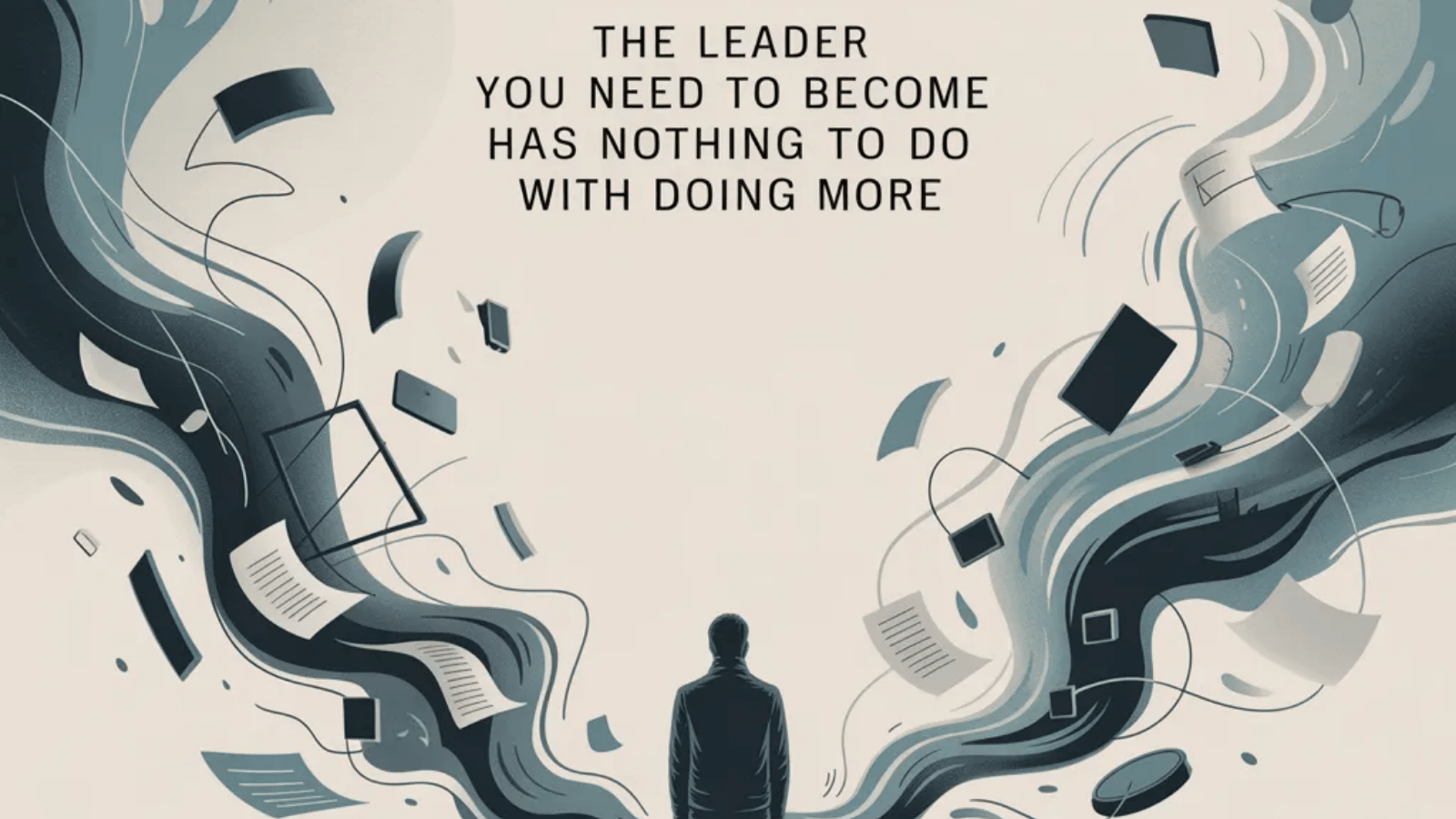
Something is quietly draining the performance of even the most capable leaders right now. Not a lack of effort, most are working harder than ever. The problem is subtler: they are sub-optimizing, running at full speed from a state that was never designed to sustain it. The gap between where they are and where they could be has everything to do with being, not doing.
This is the central insight of a conversation I had recently with Jack Swift, West Point graduate, Army Special Operations veteran, former Janus Henderson executive, co-founder of over 20 companies, and author of Level 7 Leadership.
What Jack shared is not theory. It is hard-won wisdom from a leader who ran face-first into the limits of the old model and had the courage to build something new.
Your State of Being Is Your Greatest Leadership Asset
Jack’s premise is deceptively simple: your state of being is the primary driver of your leadership and your life. Not your strategy. Not your IQ. Your state.
In my years at McKinsey and with my work at Happiness Squad, I have watched brilliant, driven leaders consistently sub-optimize, not because they lacked the right conditions inside themselves, but because they were operating from the wrong internal state. When we are running on adrenaline and cortisol, there is no genuine curiosity, no real innovation, only habitual reactions and frantic movement.
Jack experienced this firsthand as CEO of Tiffin, an AI-driven FinTech company operating at great speed and scale. The tools that had carried him through Ranger school and to the top of Janus Henderson simply stopped working. He was blue-screening and so was his entire team.
“I could smell the ammonia in the room,” he told me. That sharp smell athletes and soldiers know from extreme physical stress was rising from his entire team in weekly OKR meetings. Human systems burning on overdrive. Jack recognized it immediately. And that recognition changed everything.
Try this: → Think about your last three days. How many hours did you spend in back-to-back meetings with no transition? How often did you reach for your phone within minutes of waking? How frequently did you finish a day feeling like you moved fast but accomplished little that truly mattered? → If those questions resonate, the issue is likely not your schedule. It may be the internal state you are carrying through it. → Before your next meeting, take 90 seconds. Phone down, laptop closed. Ask yourself honestly: where am I right now? Name it — mentally, physically, emotionally. That single act of honest self-observation is where the upgrade begins.
The Courage to Sit Still
Internal coherence is the foundation everything else is built on. Not a nice-to-have. The foundation.

Coherence is the state of alignment between gut, heart, and mind. HeartMath research confirms what Jack and I have both seen: when we regulate our nervous systems and move from sympathetic overdrive to a settled parasympathetic state, we think more clearly, connect more authentically, and create from possibility rather than fear.
Jack’s reframe is one I love: think of Frank Sinatra’s famous scat — doobie doobie doo. Do, be, do, be, do. Not a permanent retreat to the mountain top. A rhythm. Take time to be before you do. Execute. Return to stillness. Act again.
One minute of this before a meeting changes the room. I have watched senior leadership teams, executives whose companies touch ~40-60% of U.S. households, sit in silence for sixty seconds and emerge measurably more present and aligned. Jack calls this rhythmic entrainment. The same phenomenon that causes grandfather clocks in the same room to synchronize over time. Human systems do the same. One coherent person can shift an entire room.
Try this: → Before your next high-stakes moment, breathe in for 4 counts, out for 8. Do this three times. Feel your feet on the ground. Drop your attention to your heart center. Then walk in. → Start your next team meeting with one minute of silence and shared breathing. Watch what shifts.
Trust Is the Speed of Your Organization
Once coherence is established in the individual, it ripples outward. And the first place it shows up is trust.
There is no speed in any organization without trust. Trying to move fast without it does not produce agility, it produces chaos.
Trust is being systematically eroded in most organizations by one entrenched belief: that the leader must have the answer. This, simply put, is ego. Not malicious, but deeply conditioned. And it is the single biggest brake on organizational speed.
The two most trust-building behaviors Jack has found, across startups and Fortune 500 boards alike, are also the most counterintuitive:
- Saying, confidently and without apology, I don’t know. Those three words reset the coherence of the room. They give permission to the ten other people around the table who also don’t know, but who may have hypotheses that together add up to something real.
- Saying, I made a mistake. Amy Edmondson’s foundational research on psychological safety showed this clearly: high-performing NICU teams logged more mistakes than lower-performing ones not because they were less competent, but because they were safer and more honest. They learned faster by naming what wasn’t working.
One of my clients instituted a monthly meeting with one purpose: share failure stories. What didn’t work. What we learned. What we’re changing. The culture did not shift overnight. It took three months of leaders sharing their own failures first, openly, without defensiveness, before others felt safe enough to follow. But when they did, creativity opened up, innovation improved, and energy that had been quietly spent on self-protection became available for something far more generative.
Try this: → In your next team conversation, say “I don’t know, what do you think?” and mean it. → Share one recent mistake with your team this week. Name what you learned. Watch the permission it gives others. → Consider a monthly “failure and learning” ritual. Leaders go first every time.
The System That Learns Together, Leads Together
Individual coherence. Relational trust. These two elements create the foundation for what Jack calls systemic learning and this is where most organizations leave enormous value untapped.
Systemic learning is not a quarterly review or a polished PowerPoint. Jack is emphatic: the moment data gets dressed up before reaching decision-makers, you’ve lost the signal. Close feedback loops fast. Push decision-making to the smallest capable unit. And critically, listen to the edges.
Jack’s insight on this stopped me: his most valuable mentors today are in their early thirties. The people on the periphery, the most junior voices, the front-line employees, they often see what’s coming long before it shows up in any dashboard.
This is something I reinforce with every leadership team I work with. Your scorecards are, at best, rear-view mirrors. At the pace of change we are navigating, new AI capabilities launching weekly, competitor landscapes reshaping in months, decisions made only on historical data will consistently solve for a world that no longer exists. Sense-making has to happen at the front line and flow upward, raw and fast, combined with data flowing downward.
That is how you navigate with both mirrors and headlights.
Try this: → Identify your most junior team members and create a direct line to their observations. Ask them what they’re seeing and hearing that isn’t in any report. → Cut the polish from your next internal review. Share raw data. Shorten the loop. Name what worked, what didn’t, and what you’re doing next. → Ask yourself: are my decisions based on what’s happening now, or what happened six months ago?
This Is the Work Now
Every external challenge facing leaders today — AI disruption, organizational complexity, the relentless pace of change — demands a more evolved leader on the inside. Jack’s work is a reminder that the most important development work you will ever do is not on your business. It is on yourself.
Learn more about Jack Swift on LinkedIn.
Listen to the podcast with Ashish and Jack Swift below, You can also listen on Apple Podcasts.
Access and subscribe to all of the episodes of the Flourishing Edge Podcast here.
Make Flourishing Your Competitive Edge.