

You Were Born for This
A Message for International Day of Happiness — March 20
What if happiness isn’t something that happens to you?
What if it’s something you’re already capable of, something that, with the right practices, you can choose, build, and grow every single day?
That’s not wishful thinking. That’s neuroscience.
Here’s the foundational insight that changes everything: our brains are neuroplastic. They are not fixed. Every thought you think, every habit you repeat, every moment you pause and choose presence over panic, these are acts of rewiring. You are literally reshaping your brain, day by day, practice by practice.
The human brain contains roughly 86 billion neurons, forming trillions of connections. And the connections that fire together, wire together. Which means the simple, unglamorous daily practices, how you start your morning, how you move your body, how you treat the person in front of you, are quietly, powerfully determining the quality of your inner life.
Happiness is not a personality trait you either have or don’t. It is a skill. And like any skill, it can be learned.
The Question Worth Asking Today
Every March 20, the world pauses to mark International Day of Happiness. I love this day not because it asks us to be cheerful, but because it asks us to be honest. To look at our lives and genuinely ask: Am I as happy as I could be? And if not, what’s one thing I could do differently?
That question is not small. For most of us, the honest answer is that we have never been taught how to be happy. And yet, we were born knowing how.
Watch a baby light up the moment someone they love walks into the room. Pure, unfiltered joy, no achievement required, no external reward needed. We arrive in this world with happiness as our natural state. Somewhere along the way, we are taught to trade it in for something else.
We were taught how to perform, achieve, and compete. We were taught what happiness looks like from the outside — the promotion, the vacation, the milestone. And so we spend our lives in pursuit of the next thing, convinced that this will be the one that finally makes us feel complete. The science has a name for this: the hedonic treadmill. We reach the goal, we feel the rush and within weeks, sometimes days, we are back to baseline, already scanning for the next thing that will fix us. The new car doesn’t do it. The bigger house doesn’t do it. Not because those things don’t matter, but because lasting happiness was never designed to come from the outside in. It was always meant to be cultivated from the inside out.
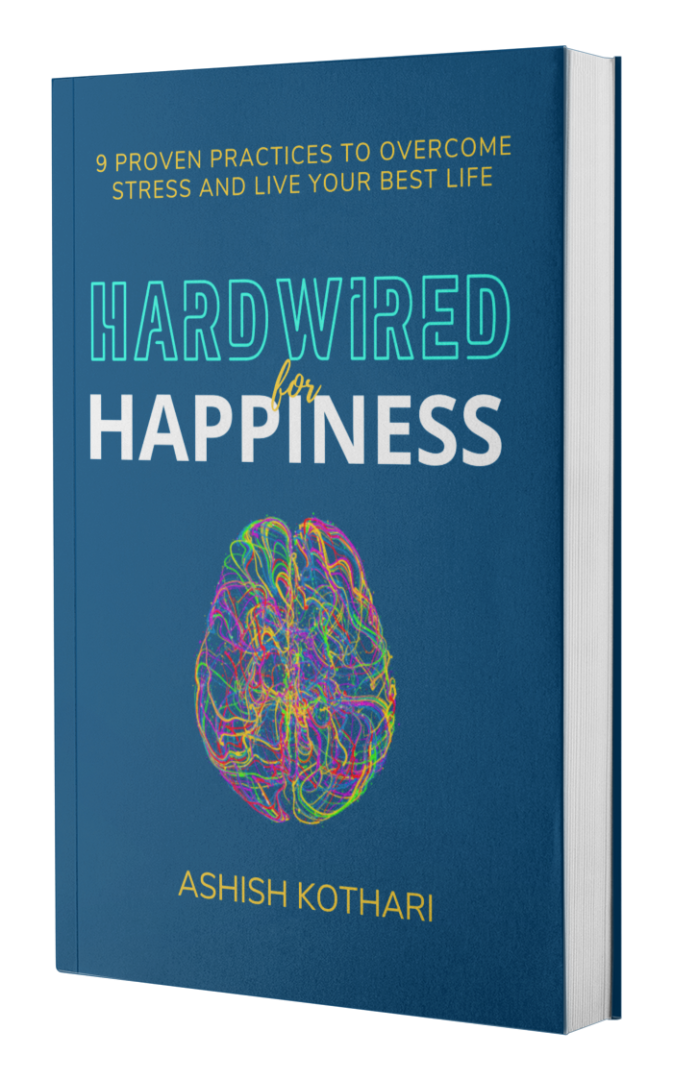
That inside-out journey is what Hardwired for Happiness is built on. Nine practices drawn from ancient wisdom traditions, validated by modern neuroscience and positive psychology, distilled into something anyone can use regardless of how busy, stressed, or skeptical they are.
Not all nine need to be your practices. But somewhere in them, something will resonate. And that’s where your rewiring begins.
The Gift of Self-Awareness
Every journey inward starts with the willingness to look.

Self-awareness is the foundational practice, the one that supports all the other eight practices. When you understand what drives you, what triggers you, what lights you up and what drains you, you stop being a passenger in your own life. You step into the driver’s seat.
And here’s the beautiful part: you don’t need much to begin. You need ten minutes and a journal. You need the discipline to ask, each morning: What am I feeling? What story am I telling myself today? Is it serving me?
That simple act of turning inward, of witnessing your own inner landscape without judgment, is the beginning of everything. It is where fear loses its grip and where choice, real choice, becomes available.
Gratitude Is a Superpower
Our brains have a built-in negativity bias. Evolution designed us to notice what’s wrong, what’s dangerous, what’s missing. In the savanna, that kept us alive. In the modern world, it keeps us dissatisfied.
Gratitude is the deliberate counterweight.
When you pause each evening and genuinely identify three things you’re thankful for that day, you are doing something profound. You are training your brain to look for evidence of abundance rather than scarcity. Over time, that shift changes not just your mood but your entire orientation to life.
This is not positive thinking. It is neurological retraining. And it takes about only minutes a day.
The world doesn’t change. Your lens does. And from that new lens, everything looks different.
Happiness Is Contagious
One of the most remarkable findings in wellbeing science is this: happiness spreads.
Research from Harvard shows that when one person in a social network becomes happier, the people around them become measurably happier too even people who don’t know each other directly. Joy, it turns out, is socially contagious. So is kindness. So is the simple act of showing up with genuine warmth for another person.
This means your inner work is never just personal. Every time you choose presence over distraction, patience over reactivity, compassion over judgment, you are not only changing your own life. You are quietly, invisibly, changing the lives of the people around you.
That is a profound responsibility. And a profound gift.
The 2025 World Happiness Report, published today by Oxford University’s Wellbeing Research Centre, found that belief in the kindness of others is among the strongest predictors of happiness across all cultures. We underestimate how kind the world actually is. And when we close that gap, when we act generously and trust that others will too, wellbeing rises for everyone.
Small Practices. Seismic Shifts.
Here is the truth about transformation that most people miss: it doesn’t happen in grand gestures. It happens in the thousand small choices you make each day.

Five conscious breaths before you open your inbox. A genuine compliment to a colleague. A walk in nature. A meal shared with someone you love. Sitting quietly for ten minutes and letting your mind settle.
None of these feel significant in the moment. Together, compounded over weeks and months, they are the architecture of a flourishing life.
Our programs, here at Happiness Squad, are grounded in exactly those principles. We don’t ask people to overhaul their lives. We ask them to integrate five-minute daily micro-practices into their lives. And the results, in resilience, joy, energy, and connection, are very positive.
Because the brain doesn’t need dramatic interventions. It needs consistent ones.
This Is Your Invitation
Today, on International Day of Happiness, you don’t need to fix everything. You don’t need a new morning routine, a meditation cushion, or a wellness subscription.
You need one practice. One moment of genuine intention. One small choice to feed what is best in you rather than what is most afraid in you.
Maybe that’s writing three things you’re grateful for before bed. Maybe it’s calling a friend you’ve been meaning to reach out to. Maybe it’s simply pausing, right now, reading this, and taking one full, conscious breath.
You were not born to merely survive. You were born to flourish.
And flourishing, the science confirms, is always only one practice away.
Happy International Day of Happiness. 🌻
Learn more about Ashish on LinkedIn.
Access and subscribe to all of the episodes of the Flourishing Edge Podcast here.
Make Flourishing Your Competitive Edge.