Rewiring Success: Why High Achievers Need a New Operating System for Flourishing

Many immigrants who grow up inherit a simple formula for life:
Work hard.
Get into the right school.
Earn the right degree.
Get the right job.
Make your family proud.
Then, one day, happiness will arrive…
For many, this formula is not just a cultural story. It was the air we breathed. We learned early that achievement was the safest path to security, respect, identity, and freedom. We were rewarded for solving hard problems, tolerating pressure, delaying gratification, and competing our way into scarce opportunities.
In many ways, that training served us well. It built discipline, resilience, analytical rigor, and the ability to perform under pressure. It helped us become founders, researchers, executives, investors, policy leaders, academics, and builders across the world.
But at some point, often in mid-career or during a major life transition, many high achievers encounter a quiet but unsettling question:
Is this all there is?
That question found me too.
For years, I lived inside the very success story I had been taught to pursue. I went from the Indian Institute of Technology (IIT), my university in India, to a high-performing career in consulting, spending more than two decades in the field, including seventeen years at McKinsey & Company.
On paper, it looked like the dream. Prestigious institution. Global firm. Complex problems. Senior clients. Smart colleagues. Meaningful work. External success.
And yet, beneath the surface, something was off.
I began to see how often success came at the cost of well-being. Not just for me, but for many of the leaders and organizations I was serving. I saw brilliant people who had achieved almost everything they had once dreamed of, yet were exhausted, anxious, disconnected, and quietly wondering why their lives did not feel as good on the inside as they looked on the outside.
I recognized parts of that pattern in myself. The striving. The inner critic. The fear of falling behind. The belief that more achievement would eventually produce more peace. The subtle but persistent voice that said: not yet, not enough, keep going.
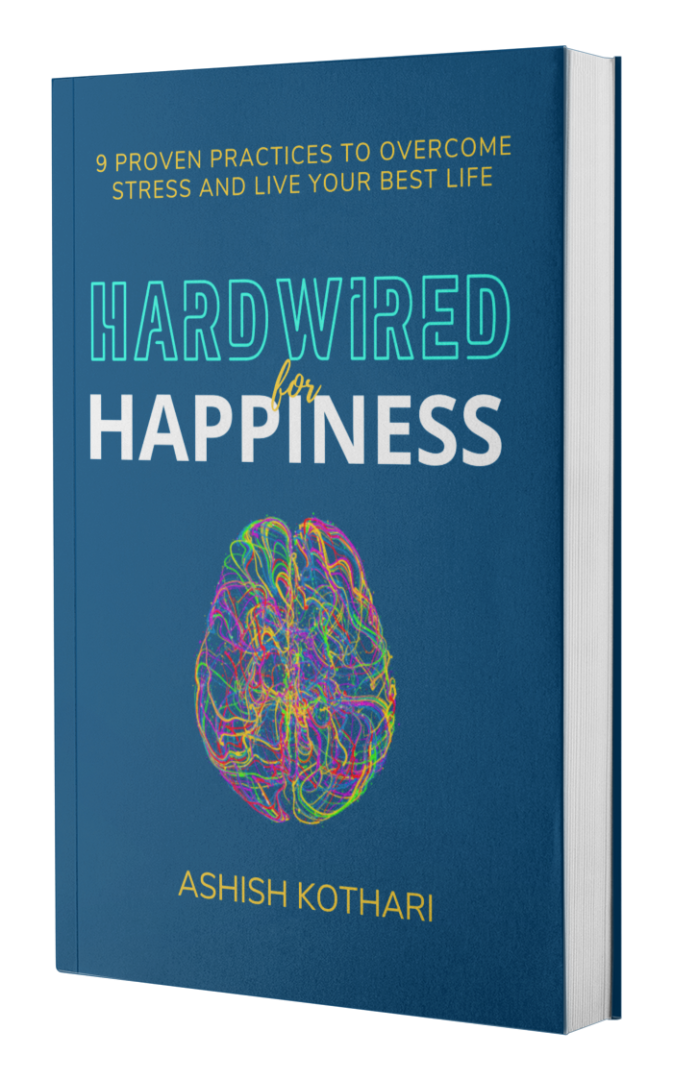
My journey into writing my book Hardwired for Happiness began with that recognition. It was a journey inward, away from fear and the endless pursuit of “more,” and toward a deeper question: What if happiness is not something we earn after success? What if flourishing is the foundation that makes success sustainable, meaningful, and generous?
That question changed my life. It eventually led me to leave McKinsey and found a company, Happiness Squad, with a mission to catalyze human flourishing and unlock full potential in individuals, teams, and organizations.
This article is an invitation to explore that same shift.
The next frontier of performance is not more achievement. It is learning how to rewire ourselves and our organizations so that success and flourishing are no longer in conflict.
The myths many of us inherited
There are several happiness myths many Indian high achievers grow up absorbing.
The first is the most powerful: happiness comes after success. This myth says joy is a reward for achievement. First the exam rank, then happiness. First IIT, then happiness. First the foreign degree, then happiness. First the promotion, the startup exit, the board seat, the financial freedom, then happiness.

But the finish line keeps moving. The mind trained to chase the next milestone does not suddenly become peaceful when the milestone is reached. It simply finds a new one.
I know this pattern well. For much of my life, I believed stress, anxiety, and sacrifice were simply the price of success. I thought if I could just get to the next level, I would finally feel settled. But the next level rarely brought lasting peace. It brought a brief moment of satisfaction, followed by the next mountain to climb.
The second myth is that sacrifice is always noble. Many of us learned to admire the person who sleeps less, works harder, carries more, and asks for little. Sacrifice can be beautiful when rooted in love and purpose. But when sacrifice becomes identity, we begin to confuse exhaustion with virtue.
The third myth is that emotions are distractions. Many high achievers are exceptionally skilled at analysis but far less practiced at emotional awareness. We learn to think our way through life, but not always to feel our way into wisdom. We become brilliant at solving external problems while remaining strangers to our internal state.
The fourth myth is that resilience means pushing through. In reality, pushing through is sometimes courage and sometimes avoidance. True resilience is not the ability to endure endlessly. It is the ability to adapt consciously, recover wisely, and respond creatively.
The fifth myth is that flourishing is personal, not strategic. We treat happiness as a private luxury rather than a core operating capacity. Yet the quality of our inner state shapes every decision we make, every relationship we build, every team we lead, and every institution we influence.
For high achievers, these myths matter because our strengths can become traps. The same drive that helped us rise can make it hard to pause. The same analytical mind that helped us solve equations can overanalyze life. The same independence that helped us leave home and build careers can leave us undernourished relationally.
The question is not whether achievement matters. It does. The question is whether achievement is being built on a foundation strong enough to sustain a meaningful life.
The paradox of modern success
We live in one of the most abundant periods in human history. We are more connected, mobile, educated, and technologically enabled than previous generations could have imagined. Yet many of us are also more anxious, distracted, lonely, and exhausted.
This is the paradox of modern success. We have more tools, but less attention. More connectivity, but less belonging. More choices, but less clarity. More convenience, but less spaciousness. More achievement, but not always more joy.
Part of the reason is neurobiological. Our brains evolved to detect danger, not to keep us continuously joyful. The fight-or-flight system that once protected us from predators now reacts to daily emails, board pressure, market volatility, family expectations, social comparison, and the endless stream of bad news on our phones.
For high achievers, this threat system is often reinforced by identity. We do not simply want to do well. We fear falling behind. We fear becoming irrelevant. We fear disappointing others. We fear that if we stop striving, everything we built will begin to collapse.
That fear can be useful for a while. It can push us to study harder, work longer, and compete more intensely. But fear is a terrible long-term operating system. It narrows attention. It hardens the heart. It makes us reactive. It convinces us that we are never safe, never done, never enough.
In my own journey, I had to confront how much of my striving was powered not by joy, service, or abundance, but by fear, scarcity, and self-protection. That realization was uncomfortable. But it was also liberating. Because what is learned can be unlearned. What is wired can be rewired.
This is why flourishing cannot be left to chance. It must be trained.
The Sunflower Model: rewiring the individual
Happiness Squad’s Sunflower Model offers a practical way to think about personal flourishing. It is built around nine practices that help us cultivate the internal conditions for a more resilient, purposeful, connected, and joyful life:
Self-awareness.
Purpose.
Mindfulness.
Gratitude.
Emotional Mastery.
Compassion and Kindness.
Well-being.
Community.
Intentional Living.
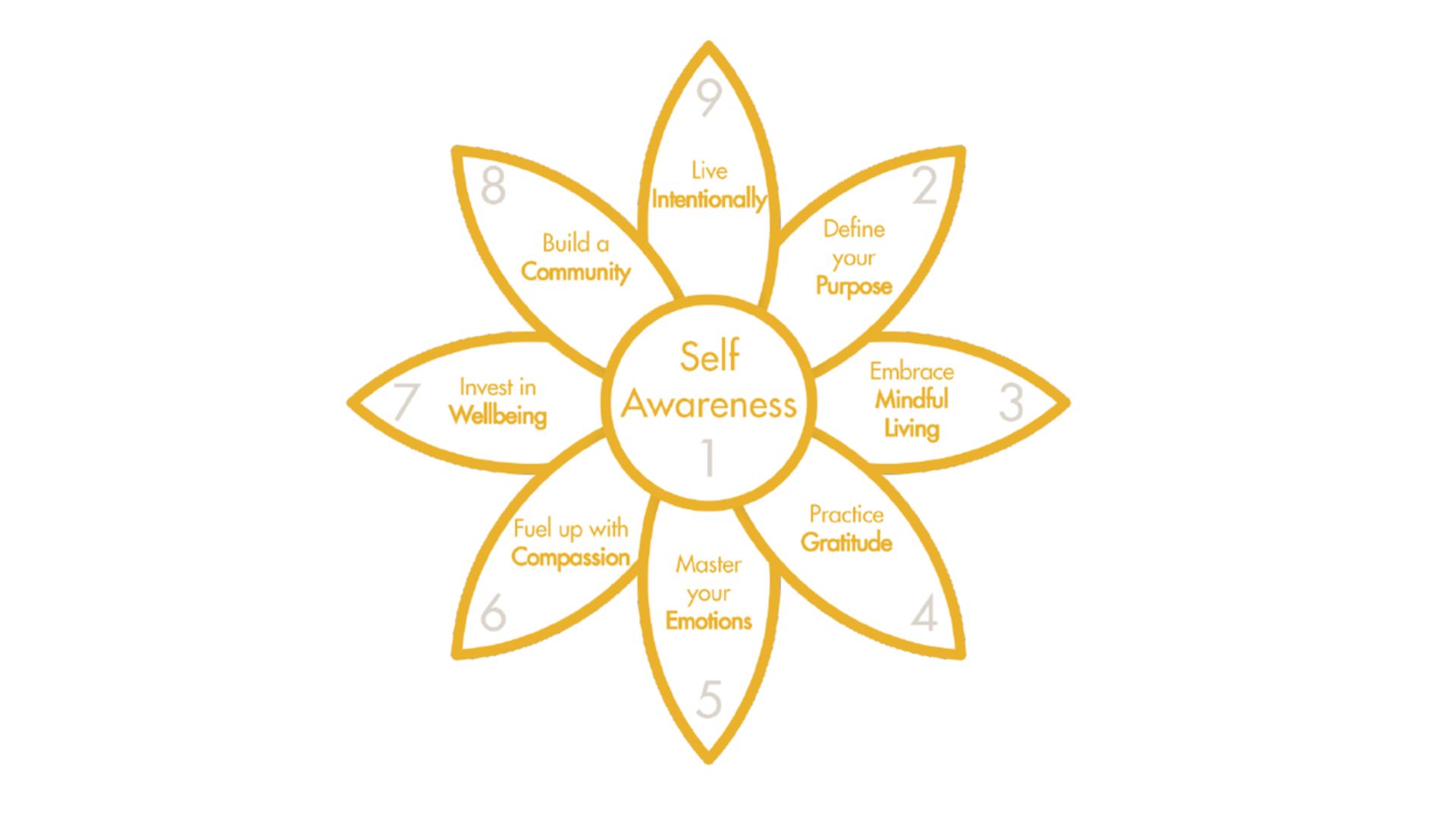
These may sound simple. But simple is not the same as easy. For high achievers, these practices can feel almost countercultural. We are used to measuring output. The Sunflower model asks us to examine input: the quality of our attention, energy, relationships, recovery, and meaning.
Self-awareness asks: What am I optimizing for now, and is it still worth optimizing for?
Purpose asks: What is my work in service of beyond status, wealth, or external validation?
Mindfulness asks: Can I be here fully, rather than living trapped in regret about the past or anxiety about the future?
Gratitude asks: Can I train my attention to notice what is already nourishing, not just what is missing?
Emotional Mastery asks: Can I respond rather than react when my ego is threatened?
Compassion asks: Can I hold myself and others with generosity without lowering standards?
Well-being asks: Am I treating my body, mind, and spirit as assets or as expendable resources?
Community asks: Who truly knows me beyond my resume?
Intentional Living asks: Are my calendar, choices, and relationships aligned with the life I claim to value?
These are not soft questions. They are strategic questions. They determine how we lead, decide, parent, partner, invest, create, and age.
In Hardwired for Happiness, I wrote about the journey from knowing to doing to being. Many of us already know what matters. We know health matters. We know relationships matter. We know presence matters. We know purpose matters. But knowing is not the same as living. The work is to convert insight into practice, and practice into identity.
That is what rewiring means.
It is not about becoming someone else. It is about returning to the wiser, more spacious, more loving, more courageous self beneath the conditioning.
The most encouraging finding from our work is that flourishing does not require perfection. Regular engagement in even a few micro-practices can begin to change the quality of our inner lives. This matters because high achievers often abandon personal growth when they cannot do it perfectly. But rewiring does not require a monastery. It requires small, repeated practices embedded into real life.
Five minutes of presence before a difficult meeting.
A weekly gratitude note to someone who shaped your life.
A walk without the phone.
A pause before reacting to criticism.
A moment of self-compassion when the inner critic gets loud.
A conversation with an old friend where you do not talk about work.
A reflection on whether your next ambition is aligned with your deepest values.
These are not escapes from performance. They are the roots of sustainable performance.
PEARL: rewiring the organization
If the Sunflower Model helps individuals rewire themselves, Happiness Squad’s PEARL Model helps leaders rewire organizations.
PEARL stands for Purpose, Energy, Adaptability, Relationships, and Life-Force. It is a framework for building workplaces where people can operate at their fullest potential.
Purpose means connecting organizational ambition to a deeper why. Many companies have purpose statements, but far fewer have activated purpose in the lived experience of employees. For leaders, the question is: Can people see how their daily work connects to something meaningful?
Energy means creating positive spirals in the workplace. Every organization has energy creators and energy drainers. Meetings, conflicts, unclear decisions, unspoken resentment, and constant urgency can deplete a team. Appreciation, constructive conflict, mutual support, and inspiration can renew it. Leaders shape this energy whether they intend to or not.
Adaptability means helping people navigate complexity without defaulting to fear. This is especially critical in an age of AI, geopolitical uncertainty, climate volatility, and rapid industry reinvention. The organizations that thrive will not be those with perfect plans. They will be those that learn, experiment, adapt, and recover faster.
Relationships means building trust, psychological safety, belonging, and constructive candor. In knowledge work, relationships are not a side issue. They are infrastructure. The quality of relationships determines the quality of collaboration, creativity, and execution.
Life-Force means designing work in ways that protect human capacity. This includes sustainable workload, fewer conflicting demands, space for deep work, recovery norms, and the ability to manage stress before it becomes burnout.
For many leaders, PEARL is a necessary correction to a common mistake: treating human beings as infinitely stretchable resources. Organizations carefully maintain physical assets, financial assets, and technological assets. But they often run human capital far below its potential through poor meetings, unclear priorities, toxic behaviors, fractured trust, and chronic overload.
The cost is enormous. It shows up as attrition, disengagement, poor decisions, absenteeism, low creativity, and underperformance disguised as busyness.
The opportunity is equally large. A flourishing organization is not one where people are merely happy in a superficial sense. It is one where people have the purpose, energy, adaptability, relationships, and life-force to do their best work sustainably.
From “doing more” to “being more”
Many high achievers respond to complexity by doing more. More meetings. More analysis. More messages. More pressure. More control.
But the future may belong to leaders who can help people be more.
More conscious.
More adaptive.
More connected.
More courageous.
More creative.
More whole.

This does not mean lowering ambition. It means upgrading the human operating system that ambition runs on.
Imagine an IIT alum leading a fast-growing technology company. The company has capital, product-market fit, and smart people. But the team is fraying. The founder is exhausted. Priorities change weekly. Meetings consume the calendar. People trust each other personally but are unclear on decisions. The leadership team says people are resilient, but the reality is that everyone is running on fumes.
A traditional response might be a wellness app, a few mental health benefits, or a one-time offsite. These may help, but they do not address the system.
A flourishing response would work at three levels.
At the individual level, leaders build practices from the Sunflower Model: self-awareness, emotional regulation, presence, well-being, purpose, and intentionality.
At the team level, they strengthen relationships, appreciation, constructive conflict, and psychological safety.
At the organizational level, they redesign work: fewer conflicting priorities, clearer decision rights, better meeting norms, protected deep work, and dashboards that measure both performance and team health.
This is the integration high-performing organizations now need: inner rewiring and system rewiring.
A practical invitation
For alumni of institutions like IIT Bombay, the invitation is not to abandon ambition. Ambition has built extraordinary lives, companies, discoveries, and impact. The invitation is to mature ambition.
Immature ambition asks: How do I win?
Mature ambition asks: What is worth winning, and who do I become in the process?
Immature ambition asks: How do I extract more from myself and others?
Mature ambition asks: How do I create the conditions for people to bring their fullest intelligence, creativity, and humanity to the work?
Immature ambition postpones happiness.
Mature ambition understands that flourishing is not the reward for success. It is the foundation that makes success sustainable, meaningful, and generous.
So here are five questions worth sitting with:
What old success myth am I still living by?
Which Sunflower Model practices would most change the quality of my life if I practiced it for five minutes a day?
Where in my organization are we creating unnecessary human capital losses through confusion, overload, or low trust?
Which PEARL dimension-Purpose, Energy, Adaptability, Relationships, or Life-Force-is the biggest unlock for my team right now?
What would I do differently if I believed flourishing was not a luxury, but my most important leadership capacity?
For many of us, the first half of life was about proving ourselves. The next chapter can be about freeing ourselves and others to flourish.
That is the new imperative.
Not success instead of happiness.
Not happiness after success.
But flourishing as the way we build, lead, and live.
Learn more about Ashish on LinkedIn.
Access and subscribe to all of the episodes of the Flourishing Edge Podcast here.
Make Flourishing Your Competitive Edge.